

10 Best Carbon Tracking Software to Simplify Emission Reporting

Tracking and managing carbon emissions is no longer optional for businesses. In the United States, new climate disclosure rules are making emissions reporting mandatory for many organisations, pushing companies to take accountability for their environmental impact. To meet these expectations, accurate monitoring has become essential for building credible sustainability strategies.
However, with so many carbon tracking software and carbon management software solutions available, finding the right one can be challenging. Every platform promises comprehensive insights, automation, and compliance support, but only a few truly deliver measurable results.
After trialling and evaluating multiple platforms, we’ve chosen the most effective options to help you make an informed choice. In this post, we’ll explore the top 10 best software for tracking carbon emissions, examining how each stacks up in features, usability, and business fit.
This guide compares the best carbon tracking software used by enterprises to measure Scope 1, 2, and 3 emissions. If you’re evaluating carbon emissions tracking software for ESG reporting, CDP disclosures, or net-zero planning, this list highlights which platforms are best suited for different business needs.
Factors to Consider When Choosing a Carbon Tracking Software
Selecting the right carbon tracking software can make the difference between surface-level reporting and meaningful climate action. To ensure your investment delivers real value, here are the most important factors to evaluate before making a decision.
1. Data Accuracy and Coverage
The best carbon emissions management software should capture emissions data across all operations and supply chains, covering Scope 1, 2, and 3. Accuracy in emission factor calculations and integration with recognised frameworks like the GHG Protocol ensures reliable, audit-ready data.
2. Ease of Integration
Your carbon management software should integrate seamlessly with existing systems - ERP, energy management, procurement, or HR platforms to automatically pull activity data. This reduces manual input, saves time, and minimises errors.
3. Reporting and Compliance
Look for carbon reporting software that aligns with global standards such as CDP, GRI, and TCFD frameworks. Built-in templates and visualisation dashboards simplify ESG disclosures and regulatory filings while ensuring transparency and consistency.
4. Scalability and Flexibility
As your organisation grows, your carbon footprint management software should scale with it. Whether you operate in one region or across multiple subsidiaries, choose a system that adapts to evolving data complexity, regulatory changes, and net zero targets.
5. Automation and AI Capabilities
Modern carbon reduction software leverages automation and AI to validate data, detect anomalies, and generate insights. These features help teams focus on strategy instead of manual calculations.
6. Supplier Engagement and Scope 3 Tracking
For most companies, Scope 3 emissions form the largest share of their footprint. Effective corporate carbon footprint software should simplify supplier engagement through surveys, shared dashboards, or API integrations to gather upstream and downstream data accurately.
7. Actionable Insights and Scenario Planning
The most effective ESG software for carbon tracking not only reports data but turns it into insights. Features like scenario modelling, forecasting, and reduction simulations help prioritise decarbonisation initiatives.
By weighing these factors carefully, organisations can identify the best software for carbon emission tracking; one that aligns with their goals, ensures compliance, and supports long-term sustainability performance.
How We Evaluated the Best Carbon Tracking Software
To identify the best carbon tracking software, we evaluated each platform across practical, enterprise-relevant criteria rather than marketing claims. Our assessment focused on:
- Scope 1, 2 & 3 coverage, including supplier data collection and lifecycle analysis
- Accuracy and audit readiness, aligned with the GHG Protocol and global standards
- Regulatory compliance support for frameworks such as CDP, TCFD, GRI, CSRD, and SEC climate disclosures
- Scalability, to support multi-entity and global operations
- Automation and integrations, reducing manual data handling
- Actionability, including scenario modelling and emissions reduction insights
Only tools that demonstrated strong performance across these areas were included in this list.
Top 10 Best Carbon Tracking Software for Companies Today

1. Breathe ESG – Best Carbon Tracking Software for Enterprise Scope 1–3 & Compliance Reporting
Breathe ESG is a comprehensive enterprise-grade platform designed for companies seeking an all-in-one solution to track, manage and report their carbon footprint, from Scope 1, 2 to complex Scope 3 emissions.
The system integrates AI and automation to simplify data collection across disparate operations and suppliers, standardises emission factor application, and generates audit-ready disclosures aligned with global ESG frameworks.
Since the tool brings measurement, analytics and reporting together, organisations can transform raw emissions data into actionable insights, scale their climate efforts with consistency, and meet increasing regulatory and stakeholder demands.

Key Features
- Automated data ingestion: Breathe ESG connects to multiple data sources; utility bills, fleet logs, supplier spreadsheets. It also uses automation to import and normalise the information, reducing manual effort and error.
- Built-in emission factor libraries: Emission factors from recognised frameworks are pre-loaded, allowing companies to apply standardised conversions (CO₂e) automatically rather than manually sourcing and importing factors.
- Scope 3 supplier engagement portal: A dedicated module enables businesses to collect upstream and downstream emissions from suppliers via structured surveys, dashboard tracking and supplier-workflow tools, making that challenging category far more manageable.
- Scenario modelling & hotspot analytics: Companies can run simulations (e.g., switching to renewables, supply-chain changes) and identify major emissions hotspots, helping prioritise investments and reduction strategies.
- Assurance-ready reporting suite: The platform produces disclosures aligned with CDP, GRI, TCFD and other frameworks, with built-in audit trails and metadata to support third-party verification and investor transparency.
- Custom dashboards & real-time monitoring: Users get interactive visualisations of emissions trends, KPIs and reduction progress across business units, enabling leadership to track performance and respond quickly.
- Advisory support integration: Beyond software, Breathe offers expert advisory services to guide target-setting, materiality assessments and strategy design, helping companies turn measurement into meaningful action.
Pros
- AI-powered automation: Significantly reduces manual data-entry and accelerates reporting cycles.
- Broad scope: supports direct operations as well as value-chain (Scope 3) emissions, which is rare in many tools.
- Audit and assurance ready: built-in frameworks and export features make compliance and verification more feasible.
- Advanced analytics: scenario modelling gives strategic insights, not just historical data.
- Corporate-centric: Solutions to engage companies manage carbon and Scope 3 emissions seamlessly.
Cons
- There's a slight learning curve where users may need brief onboarding, yet most features are intuitive after a few sessions.
- Advanced options can seem excessive for small and medium size organisations.
2. Persefoni
Persefoni is one of the most established names in carbon accounting, often referred to as the “TurboTax for carbon reporting.” Designed for large enterprises and financial institutions, it centralises emissions data management and automates complex carbon calculations using robust methodologies.
The platform ensures audit-ready accuracy by aligning with global frameworks such as the GHG Protocol and TCFD, making regulatory compliance straightforward.

Key Features
- Smart carbon accounting: Uses advanced algorithms to calculate GHG emissions with high accuracy across Scope 1, 2, and 3.
- Automated disclosure alignment: Pre-built templates for frameworks like CDP, TCFD, and SEC climate disclosures.
- Financial-grade audit trails: Every data point is traceable, ensuring regulatory confidence and investor trust.
- Integrations with ERP systems: Syncs directly with major systems such as SAP, Oracle, and Workday.
Pros
- Excellent for large organisations with complex supply chains.
- High-level automation and data accuracy.
- Investor-friendly reporting and assurance capabilities.
Cons
- Premium pricing model suitable mainly for large enterprises.
- Can be complex for smaller teams to configure initially.
3. Plan A
Plan A is both a sustainability platform and a consultancy, offering comprehensive carbon accounting and ESG management solutions. Its science-based approach and user-friendly dashboards make it a strong contender for mid-sized to large organisations.
Plan A helps companies identify emissions hotspots, model reduction strategies, and stay aligned with evolving EU sustainability regulations.

Key Features
- Data-driven decarbonisation tools – Identifies emission hotspots and recommends reduction strategies.
- EU Taxonomy and CSRD compliance – Keeps businesses aligned with European reporting mandates.
- Collaborative ESG tools – Enables team workflows across sustainability, finance, and operations.
- Dynamic dashboards – Visualises performance metrics and progress toward net-zero goals.
Pros
- Excellent UX and design simplicity.
- Strong compliance alignment for EU-based companies.
- Deep analytics for emissions reduction planning.
Cons
- Primarily tailored for European frameworks.
- Integration setup may require external support.
4. Emitwise
Emitwise focuses on automating carbon accounting through AI and machine learning, making it an ideal platform for manufacturing, logistics, and supply chain-heavy companies. It continuously collects and analyses emissions data to provide real-time visibility across operations and suppliers.
By using intelligent estimation models, Emitwise fills data gaps and improves accuracy without manual intervention.

Key Features
- Real-time carbon tracking: Updates emissions data continuously through integrated sources.
- AI-based data estimation: Fills gaps in incomplete datasets with machine-learning models.
- Supplier collaboration hub: Simplifies Scope 3 data collection and engagement.
- Scenario analysis: Models carbon reduction outcomes based on operational changes.
Pros
- Highly efficient automation and AI tools.
- Effective for industries with large operational footprints.
- Delivers actionable insights quickly.
Cons
- Pricing is not transparent for smaller businesses.
- Limited customisation for niche sectors.
5. IBM Envizi
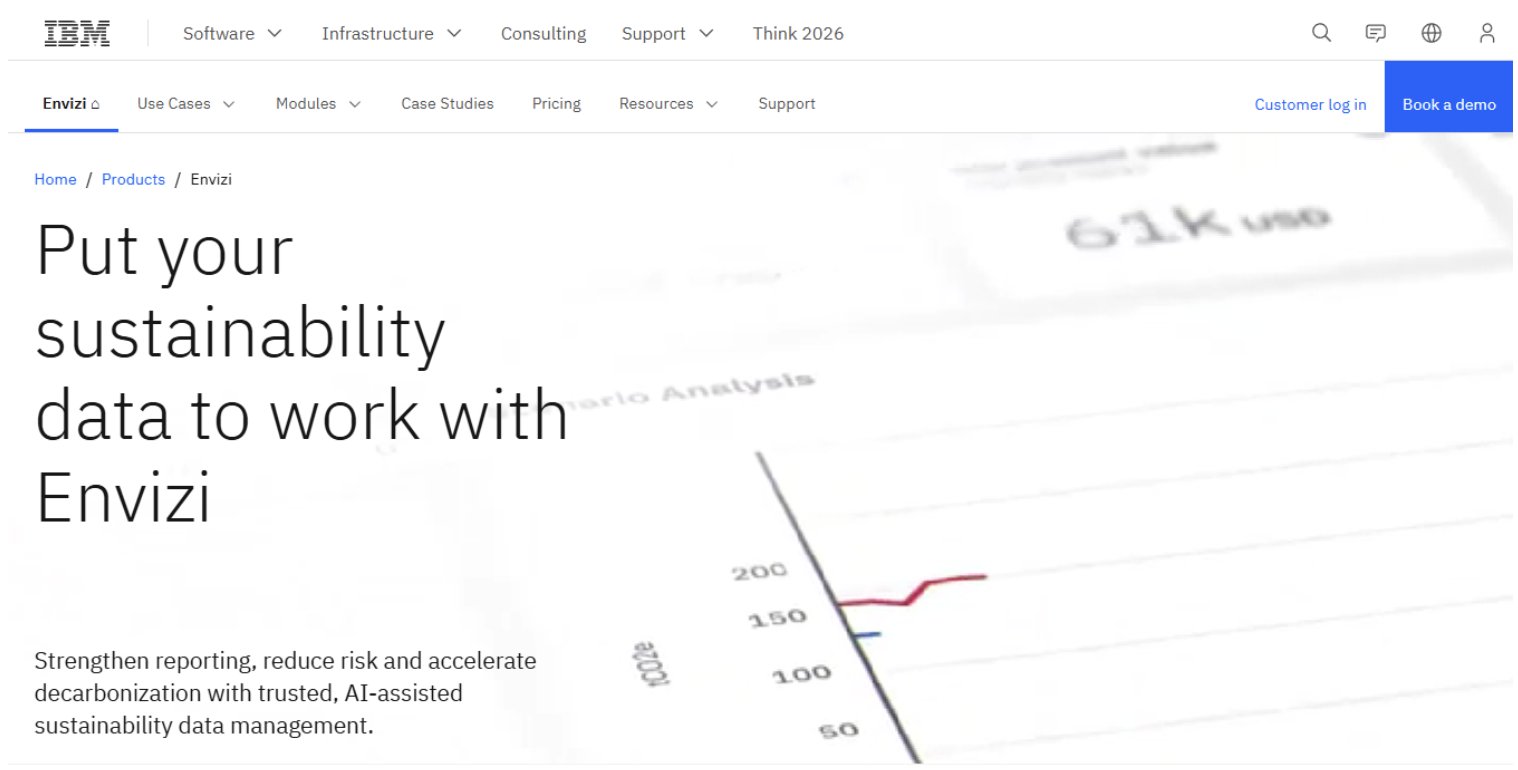
Envizi, now part of IBM, is a robust sustainability and ESG data management platform. It combines carbon accounting with advanced analytics to help enterprises meet compliance and performance goals.
The system unifies data from energy, waste, and operational sources to deliver a complete view of sustainability performance.
Key Features
- Automated data management – Consolidates data from energy, waste, and operations.
- Powerful analytics engine – Offers deep performance and cost optimisation insights.
- Integration with IBM suite – Works seamlessly with IBM’s AI and sustainability tools.
- Comprehensive compliance support – Aligns with GRI, CDP, and SASB frameworks.
Pros
- Ideal for global enterprises with large data volumes.
- Backed by IBM’s technology and infrastructure.
- Offers extensive compliance coverage.
Cons
- Requires technical expertise to set up.
- Interface may feel overwhelming for beginners.
6. Watershed
Watershed is an enterprise-grade platform that combines carbon accounting, reduction modelling, and advisory services into one tool. It aims to help businesses measure their emissions, set targets, and act with confidence, especially in complex operations and global supply chains.
The carbon reporting software offers full Scope 1–3 coverage, providing detailed lifecycle insights and audit-grade data for regulatory reporting.

Key Features
- Scope 1-3 & lifecycle analysis – Supports full emission coverage including supply chain and product lifecycle, giving a comprehensive view of footprint.
- Audit-grade reporting – Delivers traceable data and documentation so companies can meet external assurance and regulatory expectations.
- Reduction modelling & scenario tools – Enables companies to simulate changes such as electrification or renewables and observe potential emission impacts.
- Enterprise data governance & integrations – Built for global operations, with strong access controls, security, and system integrations.
Pros
- Very strong coverage for complex supply chains and lifecycle scope
- High credibility for large organisations and investor-grade disclosures
- Offers modelling tools not just static reporting
Cons
- Premium pricing may limit accessibility for smaller companies
- Implementation time may be longer for non-specialist users
- Some features require advanced setup or support
7. Greenly
Greenly is a user-friendly carbon accounting platform ideal for mid-sized companies looking to simplify their emissions tracking and engage their suppliers. Designed for full Scope 1, 2, and 3 coverage, it emphasises usability and automation.
The carbon emissions management software connects seamlessly with business systems to collect real-time data and generate clear, actionable insights.

Key Features
- Full Scope 1-3 coverage – Enables emissions tracking across direct operations, purchased energy and supply chain activity.
- Real-time integration & analytics – Pulls data automatically from systems to keep dashboards current and actionable.
- Supplier collaboration hub – Offers tools to engage vendors and gather supply chain emissions efficiently.
- Reduction insights & recommendations – Provides actionable guidance on how to reduce emissions and track progress.
Pros
- Accessible UX for companies just starting on carbon reporting
- Good value compared to enterprise-grade platforms
- Strong supplier engagement capabilities
Cons
- May lack the depth of modelling tools found in more expensive solutions
- Customisation options may be limited for complex multinational needs
8. Diligent ESG
Diligent is a comprehensive ESG software suite with a carbon accounting component, popular among organisations wanting to integrate governance, risk, and sustainability in a single platform.
Diligent also brings emissions tracking, compliance management, and performance monitoring together in one unified system. With pre-built reporting templates and real-time dashboards, the carbon footprint software simplifies ESG disclosures and supports transparent decision-making.

Key Features
- Integrated data platform for ESG – Combines emissions tracking with risk and governance modules for holistic reporting.
- Audit-ready reporting templates – Pre-configured reports for sustainability and emissions disclosures aligned with standards.
- Real-time dashboards – Enables executives to monitor performance and respond to sustainability issues promptly.
- Compliance and certification support – Offers modules supporting climate disclosure, verification and governance programmes.
Pros
- Strong fit for companies already focused on ESG risk and governance
- Single platform for combined carbon and ESG management
- Good for regulatory compliance and structured reporting
Cons
- Carbon tracking features may not be as specialised or deep as dedicated platforms
- Higher cost-structure for smaller firms
- May require additional consulting support for full implementation
9. Sinai Technologies
Sinai Technologies is one of the best carbon footprint reporting software focused on helping organisations monitor, set targets, and remove limit emissions. The software combines precision measurement with smart reporting solutions and supports full Scope 1–3 coverage.
The best part? The carbon reduction software includes cost analysis features to identify the financial impact of reduction efforts.

Key Features
- Emission factor database – Uses reputable databases (like IPCC, EPA) for transparent and auditable emission calculations.
- Removal & offset tracking – Offers tools to account for carbon removal projects as part of the strategy.
- Full scope coverage – Addresses Scope 1, 2 and 3 with supplier inputs and lifecycle modelling.
- Custom analytics & cost-savings insight – Provides insights on both emissions and operational cost savings through reduction efforts.
Pros
- Strong for companies focused on removal and offset components
- Transparent methodology and emission factor support
- Good for organisations ready to move beyond basic tracking
Cons
- Bundled features may add cost, making it less attractive to early-stage users
- Fewer integrations and ecosystem partnerships compared to major enterprise players
10. Net Zero Cloud
Net Zero Cloud (from Salesforce) is a cloud-native carbon management solution built on the Salesforce ecosystem. It’s designed for organisations already using Salesforce or those seeking a platform that seamlessly integrates CRM with sustainability operations.
The corporate carbon footprint software connects business activity data directly to emissions metrics, offering real-time tracking and scenario modelling for reduction planning.

Key Features
- CRM integration with carbon data – Links emissions data to business operations and stakeholders within the Salesforce platform.
- Scenario planning & forecasting tools – Lets companies model different decarbonisation pathways and monitor impacts.
- Offset & removal management – Enables tracking of carbon credits and offsets inside the same interface.
- Full Scope 1-3 support – Covers all emission scopes with data and reporting features for enterprises.
Pros
- Excellent for Salesforce-centric organisations seeking integrated sustainability & CRM
- Built by a major vendor with strong support ecosystem
- Good scenario tools and breadth of features
Cons
- Often tied to Salesforce licensing costs and ecosystem dependencies
- Could be over-engineered for smaller organisations not already within Salesforce
- Some users report slower customisation for carbon-specific workflows
Which Carbon Tracking Software Is Best for CDP and ESG Reporting?
Not all carbon tracking tools are equally suited for ESG disclosures. Platforms built primarily for internal tracking may fall short when it comes to investor-grade reporting and third-party assurance.
For organisations reporting to CDP, TCFD, GRI, or preparing for CSRD, the most effective carbon tracking software offers:
Built-in disclosure templates mapped to ESG frameworks
The most effective carbon tracking platforms include pre-configured templates aligned to major ESG frameworks such as CDP, Global Reporting Initiative, and the Task Force on Climate-related Financial Disclosures.
These templates map emissions data directly to required disclosure questions, helping organisations produce consistent, structured, and submission-ready reports without manual reformatting.
Traceable audit trails for every data point
Investor-grade reporting depends on transparency. Leading carbon tracking software records the source of each data input, the emission factors applied, calculation methodologies used, and any changes made over time. This creates a defensible audit trail that supports third-party assurance and strengthens confidence in reported figures.
Version control and documentation for assurance reviews
Robust version control allows sustainability teams to track revisions, compare reporting periods, and maintain clear documentation for internal and external review. During assurance processes, this functionality ensures that every update is timestamped, attributed, and supported by evidence, reducing the risk of discrepancies.
Clear linkage between emissions data and ESG narratives
Strong ESG reporting connects quantitative emissions data with climate strategy, governance, and risk disclosures. Advanced platforms enable organisations to align carbon metrics with transition plans and climate-related financial risks, creating a cohesive report that meets regulatory and investor expectations.
Enterprise-grade platforms like Breathe ESG, Persefoni, Watershed, and IBM Envizi stand out here, as they combine accurate carbon accounting with disclosure-ready reporting workflows.
Carbon Tracking Software vs Carbon Management Software: What’s the Difference?
Carbon tracking software focuses on measuring and reporting emissions, while carbon management software goes a step further by enabling analysis, reduction planning, and strategic decision-making.
- Carbon tracking software helps calculate Scope 1, 2, and 3 emissions accurately and supports compliance reporting.
- Carbon management software combines tracking with scenario modelling, reduction roadmaps, supplier engagement, and progress monitoring toward net-zero targets.
Businesses early in their sustainability journey may start with tracking, but organisations facing regulatory scrutiny or net-zero commitments benefit most from platforms that offer end-to-end carbon management.
How to Choose the Right Carbon Tracking Software for Your Business?
Choosing the right carbon tracking software depends on your regulatory exposure, data complexity, and sustainability maturity. Organisations with global operations, supplier-heavy value chains, or assurance requirements should prioritise platforms that combine automation, accuracy, and compliance readiness.
The right solution should not only measure emissions but also support long-term climate strategy and reporting obligations.
Selecting a software requires aligning software capabilities with your organisation’s structure, reporting demands, and climate ambition. To make the selection process more practical, break your evaluation into the following key areas.
1. Assess Your Organisational Complexity
The structure of your operations directly determines the features required in a carbon tracking platform.

Complex organisations often underestimate the importance of integration depth. If emissions data must flow from multiple systems, ERP, procurement, utilities, logistics, automation becomes essential rather than optional.
2. Understand Your Regulatory Exposure
Carbon reporting requirements are expanding rapidly across jurisdictions. Before selecting a platform, clarify:
- Which disclosure frameworks apply to your business
- Whether third-party assurance is required
- How frequently reports must be produced
- Whether investor scrutiny is expected
If your organisation reports under regulators such as CSRD, CDP, GRI, or TCFD frameworks, your platform should provide structured outputs aligned with these standards. Look for:
- Built-in compliance mapping
- Pre-configured reporting templates
- Version control and documentation logs
- Clear emission factor transparency
- Regulatory alignment reduces reporting risk and simplifies audit preparation.
3. Evaluate Data Complexity and Scope 3 Needs
For many organisations, Scope 3 emissions represent the largest share of their carbon footprint. This is also where data collection becomes most challenging.
Always cross-check with the following questions:
- Do you rely heavily on suppliers across regions?
- Are supplier emissions currently estimated or verified?
- Do you need primary data collection tools?
- Will suppliers need access to the platform?
Software that includes supplier engagement portals, automated data requests, and estimation models can significantly reduce manual effort and improve accuracy over time.
4. Align Software with Your Sustainability Maturity
Not all organisations are at the same stage of their climate journey. The platform you choose should reflect your current needs while supporting future growth.
- If you are measuring emissions for the first time: Focus on intuitive dashboards, structured onboarding, and clear data collection guidance.
- If you are setting reduction targets: Look for scenario modelling tools, target tracking features, and performance forecasting.
- If you are actively executing decarbonisation strategies: Prioritise granular analytics, supplier collaboration tools, and progress monitoring capabilities.
- If you are pursuing net-zero commitments: Ensure the platform supports long-term transition planning, audit readiness, and cross-functional reporting.
5. Consider Implementation and Internal Adoption
Even the most advanced carbon tracking platform will underperform if it is difficult to implement or adopt internally. Implementation timelines, technical integration requirements, and onboarding support should be evaluated early in the decision process. A solution that integrates smoothly with existing ERP systems, procurement platforms, and financial tools will reduce friction and accelerate time to value.
Sustainability teams, finance departments, procurement leads, and executive stakeholders should all be able to access and interpret emissions data without relying on complex technical intervention. Software that encourages cross-functional collaboration strengthens internal accountability and improves long-term reporting consistency.
6. Look Beyond Measurement
Carbon tracking software should function as more than a reporting tool. While accurate emissions accounting is foundational, the real value lies in the insights generated from that data. The most effective platforms help organisations identify emissions hotspots, analyse performance across business units, model reduction pathways, and monitor progress against climate targets.
As regulatory pressure and stakeholder expectations increase, companies benefit from systems that transform raw emissions data into strategic intelligence. Selecting a platform that supports forward-looking decision-making ensures that carbon management becomes embedded in operational planning rather than treated as a periodic compliance exercise.
.jpg)
Simplify Carbon Tracking with Smarter Solutions
We’ve explored some of the best carbon tracking software options available today, each bringing valuable capabilities to the table. However, many still face common challenges; complex setup processes, high costs, limited scalability, and a lack of real-time accuracy. These issues can make it difficult for businesses to maintain consistent, audit-ready carbon reporting software performance and achieve meaningful reductions.
With AI-powered carbon emissions management software like Breathe ESG, these barriers disappear. Breathe’s automated data collection streamlines Scope 1, 2, and 3 tracking, while its intuitive dashboards ensure real-time insights and compliance with global standards. The platform’s scalability suits both startups and enterprises, and its assurance-ready analytics simplify verification and ESG disclosures.
Breathe ESG empowers organisations to go beyond tracking — to act on insights, reduce emissions, and report with confidence.
Book a free demo to explore our advanced carbon tracking capabilities today.
FAQs
What is Scope 3 and why is it important?
Scope 3 covers indirect emissions across the value chain, such as suppliers, transport, product use, and waste. It often represents the largest portion of a company’s footprint and drives meaningful reduction efforts.
How does carbon tracking software support ESG reporting?
Carbon tracking software centralises emissions data, simplifies calculation, and aligns reporting with standards like CDP and GRI. It boosts transparency and consistency for stakeholder disclosures.
Can carbon tracking software help with net-zero goals?
Yes. Software like Breathe ESG offer end-to-end measurement and strategy workflows that clarify reduction pathways and monitor progress toward net-zero.
How long does implementation typically take?
Implementation varies with data complexity, but most enterprise carbon tracking platforms are operational within weeks. Time depends on integration with internal systems and supplier data readiness.

