

Top 7 Scope 3 Software Platforms in 2026

For most companies, Scope 3 is the hardest part of carbon accounting because it covers emissions across the wider value chain, including suppliers, logistics, product use, business travel, and end-of-life disposal. These emissions are often outside a company’s direct control and rely on data from many third parties, making them harder to measure accurately.
This is why choosing the right Scope 3 software matters.
A Scope 3 software platform should support the full process, from collecting data and engaging suppliers to identifying emissions hotspots and building reduction plans. This makes it far more useful than a basic Scope 3 calculator or spreadsheet replacement, especially when companies need to manage complex value-chain emissions at scale.
Let’s explore the best Scope 3 platforms in 2026 and what each one has to offer.
The 7 Best Scope 3 Emissions Software: A Quick Overview

The Best Scope 3 Software In 2026
1. Breathe ESG
Breathe ESG is an AI-powered ESG reporting and carbon management platform built to help companies turn sustainability from a fragmented reporting exercise into a structured business process. It supports organizations in simplifying compliance, tracking emissions, and building transparent ESG systems that can scale with regulatory and stakeholder expectations.
Instead of treating ESG as a checklist, it positions sustainability as something businesses can measure, manage, and improve over time. Its Breathe Zero solution is positioned around the realities of value-chain emissions, where supplier participation, activity data, calculation methods, and long-term net-zero planning all need to work together.
By connecting value-chain emissions with broader ESG accountability and net-zero ambition, Breathe ESG helps businesses move toward more complete and credible climate action.
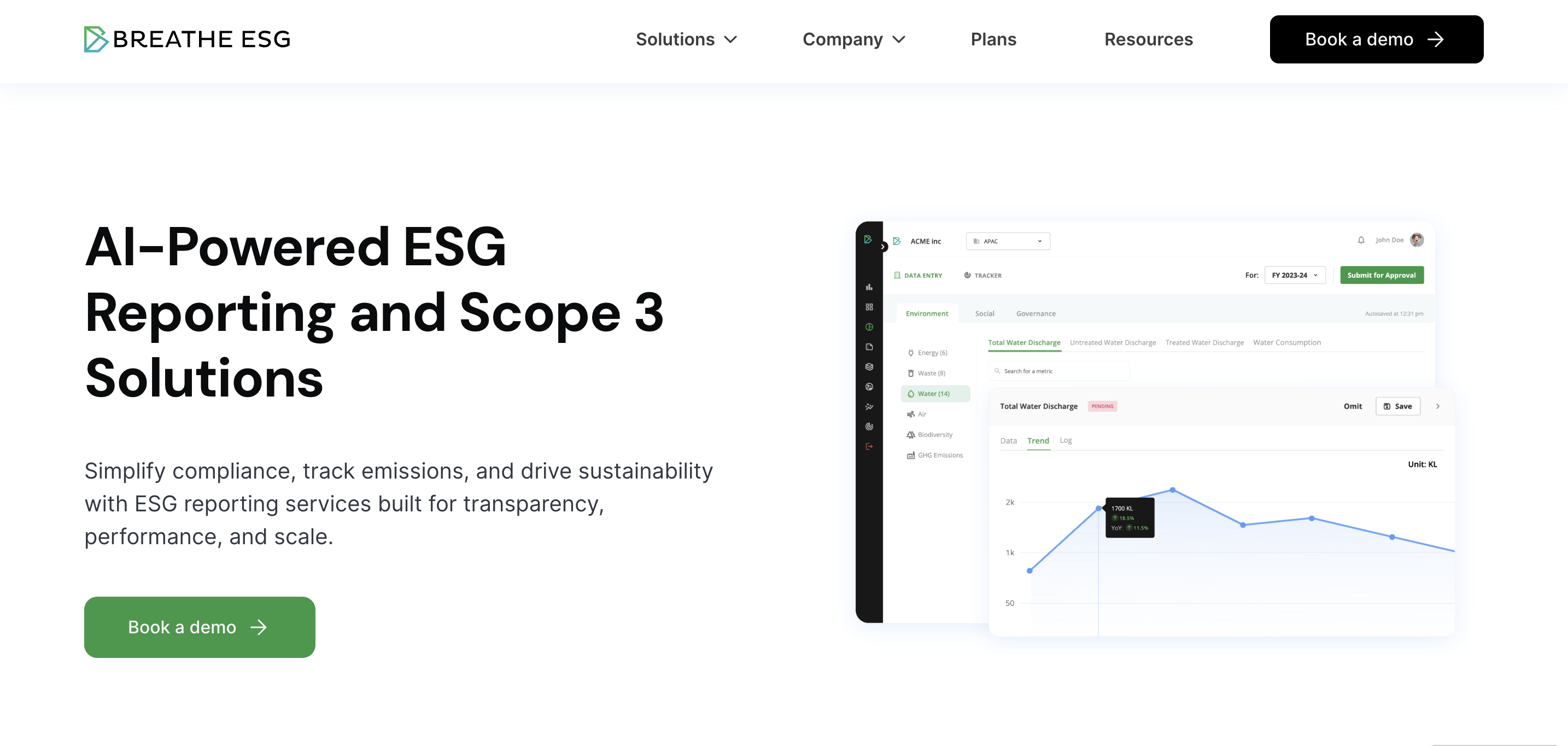
Key Features Of Breathe ESG
- Automated data capture: Connect utilities, ERP, HR, and other business data so Scope 1, 2, and 3 figures update in a more continuous, less manual way.
- Scope 3 supplier data collection: Collect supplier and stakeholder inputs through bulk uploads, API integrations, and supplier-facing workflows to improve coverage across categories.
- Customizable calculation methodologies: Adapt the Scope 3 calculation tool to your current data maturity, then refine methods as supplier-specific data improves.
- Hotspot analysis and predictive dashboards: Identify anomaly spikes, future hotspots, and the categories or suppliers that deserve attention first.
- Disclosure and target-setting in one flow: Generate framework-aligned outputs and model science-based pathways without splitting reporting from reduction planning.
2. Watershed
Watershed is an enterprise sustainability AI platform built to help companies turn climate data into business-grade decisions. What makes it stand out is the depth of its climate intelligence: Watershed combines a large emissions-factor database, transparent methodologies, and embedded expertise from climate, policy, and reporting specialists.
Its uniqueness comes from combining rigorous data infrastructure with credibility signals such as CDP accreditation and recognition in Verdantix’s enterprise carbon management research.
Rather than treating Scope 3 as a side calculation, Watershed frames value-chain emissions as a business intelligence challenge connected to procurement, suppliers, and operational choices.

Key Features Of Watershed
- Integrated supplier engagement: Built-in workflows, portals, and scorecards help scale supplier outreach and follow-up.
- Audit-ready Scope 3 measurement: Watershed emphasizes granular measurement, transparent lineage, and supplier intelligence in one flow.
- AI-powered product footprints: Product-level insights help connect procurement choices with emissions outcomes.
3. Persefoni
Persefoni, a carbon accounting and climate management platform, helps organizations understand their greenhouse gas emissions across Scope 1, Scope 2, and Scope 3.
When applied to Scope 3, Persefoni is especially relevant to the emissions that sit across a company’s wider value chain, including upstream and downstream activities that the company influences but does not directly own or control.
This makes it useful to introduce in discussions about the growing need for clearer, more reliable value-chain emissions data.
Its relevance in Scope 3 comes from helping companies treat value-chain emissions as a material business issue connected to suppliers, stakeholders, regulation, and long-term climate strategy.
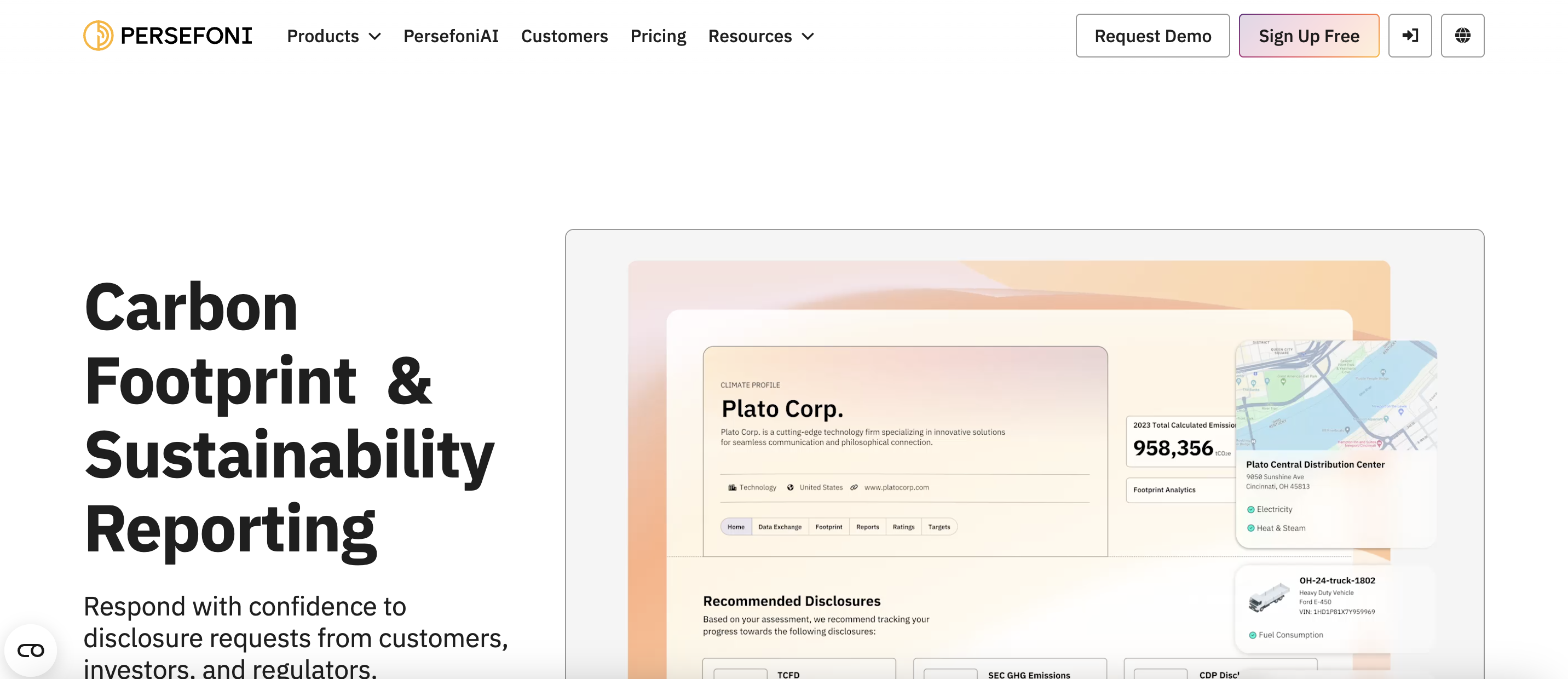
Key Features Of Persefoni
- Spend-based estimates to actuals: Persefoni supports progressive Scope 3 maturity rather than requiring perfect supplier data from day one.
- Supplier data exchange: Suppliers can measure and share their footprints instead of only replying to questionnaires.
- Finance-aligned carbon reporting: Strong fit for organizations that want carbon accounting to sit closer to governance and reporting workflows.
4. Pulsora
Pulsora is often known as an enterprise sustainability management platform that brings carbon accounting into a more structured and transparent process.
As climate reporting expectations grow, companies need a clearer way to connect emissions measurement with accountability and decarbonization planning. Pulsora supports that shift by helping organizations work with more traceable carbon data and a broader understanding of where emissions are created across the business ecosystem.
Within Scope 3 discussions, it can be positioned as part of the move toward more reliable value-chain emissions management and decision-making.

Key Features Of Pulsora
- Complete value-chain data collection: Pre-formatted templates, automated request workflows, and integrations help centralize carbon data across the business and value chain.
- Flexible Scope 1 2 3 calculations: Supports multiple methods, factors, and estimation approaches for comprehensive reporting.
- Audit trails plus decarbonization insights: Strong controls on one side, strategy support on the other.
5. Sweep
Sweep is a sustainability data platform that helps companies understand and manage emissions across their organization and wider value chain.
The company frames value-chain emissions as a data challenge as much as a climate challenge. Scope 1, 2, and 3 data can sit across different teams, suppliers, systems, and geographies, which makes it difficult to form one reliable measurement of a company’s full footprint.
Sweep’s directly addresses that complexity, with a focus on bringing scattered sustainability data into a more connected and usable structure.

Key Features Of Sweep
- Streamlined supplier data collection: Gather carbon data from suppliers across the value chain within one platform.
- Collaborative reduction planning: Set joint targets and monitor progress with partners.
- Partner-friendly access model: Sweep says it does not charge partner companies for using the platform.
6. Normative
Normativ approaches Scope 3 from the perspective of defensible carbon accounting: numbers that can be explained clearly to auditors, leadership teams, investors, and customers.
Rather than treating emissions data as a loose estimate, Normative presents carbon measurement as a structured record built around GHG Protocol standards and independently evaluated methodology.
A distinctive part of Normative’s Scope 3 message is the idea that value-chain emissions can dominate a company’s footprint, sometimes representing around 90% of business emissions.
Normative also connects Scope 3 work with the broader business need to prepare for compliance, audits, customer expectations, and net-zero planning. Its tone is less about simply collecting carbon data and more about creating emissions figures that a company can stand behind in formal reporting and strategic decisions.

Key Features Of Normative
- AI-assisted data ingestion: Automates categorization and quality control so teams spend less time cleaning data.
- Verified Scope 1 2 3 accounting: Built to GHG Protocol standards and independently verified by TÜV SÜD.
- Supplier data ecosystem: Carbon Network and EcoVadis connections strengthen Scope 3 confidence.
7. SINAI
SINAI stands as an enterprise carbon management and sustainability platform built around the connection between emissions, decarbonization, and business decision-making.
Its positioning is especially relevant for larger, multi-site companies that need to understand climate impact across complex operations and extended value chains.
SINAI also has a strong association with industries where emissions are operationally complex, such as manufacturing, logistics, food and beverage, metals and mining, finance, and consumer goods.
That industry orientation gives its Scope 3 narrative a practical tone, since value-chain emissions in these sectors often depend on many factors beyond the company’s direct control.

Key Features Of SINAI
- Large factor library for faster screening: SINAI highlights 40,000-plus emission factors to help identify hotspots without waiting for every supplier input.
- Supplier-specific data collection: Supports verified supplier data and customized factors to improve Scope 3 accuracy.
- Integrated decarbonization and financial modeling: Links Scope 3 accounting with scenario modeling and financially viable transition plans.
How To Choose The Right Scope 3 Software?
Choose Scope 3 software that supports accurate data collection, supplier engagement, emissions-factor management, hotspot analysis, and reduction planning across your full value chain. The right platform should also fit your company’s reporting needs, integrate with existing systems, and scale as your Scope 3 program matures.
1. Match the software to your emissions profile and data maturity.
The right platform depends on where your Scope 3 emissions sit and how strong your data already is. If you need a broad platform covering Scope 1, 2, and 3 with reporting, automation, and reduction planning, Breathe ESG is a strong place to start.
If supplier engagement at scale is the priority, Watershed and Sweep stand out. For finance integration, Persefoni is compelling while methodological rigor and deeper advisory support is provided by Normative. If you need a more industrial decarbonization lens, SINAI is worth close consideration.
Look for one platform that can handle reporting, screening, and reduction.
A strong buying framework is simple: choose software that works as a Scope 3 reporting tool, a screening tool, and a reduction tool in one environment. That gives you a clearer path from measuring emissions to acting on them.
2. Choose software that supports a phased data journey.
The best platforms let you start with screening estimates, improve over time with higher-quality supplier data, and then turn that information into targets, scenario planning, and practical reduction actions. This aligns with the GHG Protocol’s guidance to begin with screening and then select methods based on relevance, data availability, data quality, and effort.
3. Decide how much support you need alongside the software.
Some companies want a pure software platform, while others need a more consultative model. Breathe ESG and Normative appear to offer stronger support around the platform, while others lean more toward enterprise software workflows. For many companies, that support can matter just as much as the software itself.

How Scope 3 software helps with emissions reduction
The best Scope 3 emissions management software does more than calculate a footprint. It helps teams identify hotspots, prioritize categories, target the suppliers or products driving the largest impact, and track progress against reduction pathways.
That is why modern buyers increasingly want a Scope 3 carbon emissions tracking software stack that supports both quantification and action.
Good platforms also make it easier to improve data quality over time. Companies often begin with screening estimates, then layer in supplier-specific information, then push further into product-level or scenario-based work.
In practice, a useful Scope 3 calculator tool should evolve into a broader Scope 3 emissions reporting tool and eventually into a Scope 3 carbon footprint solution that informs procurement, target setting, and decarbonization investment.
That progression matters because Scope 3 is rarely static. Suppliers change, products change, emission factors improve, and reporting expectations tighten. The platforms that create the most value are the ones that combine measurement, engagement, reporting, and action in a way that makes emissions reduction easier to sustain year after year.

Streamline Scope 3 management with Breathe ESG
All platforms above can help companies measure and manage value-chain emissions. They each cover important parts of the stack, whether that is supplier collaboration, carbon accounting, auditability, or reduction planning.
However, Breathe ESG stands out because it brings more of that stack together in one place. It is not only a Scope 3 company with strong reporting capabilities, but also a practical Scope 3 solution that extends into methodology control, hotspot visibility, target setting, and implementation support.
It helps unify data, improve data quality, reduce spreadsheet dependency, and turn emissions reporting into a smarter reduction program. That is the kind of platform most companies ultimately need when Scope 3 becomes material.
Book a discovery call today to streamline Scope 3 emissions with Breathe ESG.
FAQs
Which carbon tracking software includes Scope 3?
Several leading platforms include Scope 3 today, including Breathe ESG, Watershed, Persefoni, Pulsora, Sweep, Normative, and SINAI. If you are specifically looking for carbon tracking software Scope 3 emissions, carbon tracking software with Scope 3, or a broader scope 1, 2, and 3 emissions tool, those seven all belong on the shortlist.
What is the best software for Scope 3 emissions?
For organizations that want a connected Scope 1, 2, and 3 software environment with reporting, reduction planning, and supplier workflows in one place, Breathe ESG is one of the strongest options. For large supply-chain programs, Watershed is excellent while finance-aligned carbon accounting suits Persefoni.
Why is Scope 3 so hard?
Scope 3 is hard because it spans 15 value-chain categories and relies heavily on supplier and proxy data. Better methods improve accuracy, but they usually require more time and effort too.
What is the leading software for carbon measurement?
There is no single leader for carbon measurement software. However, several lists in 2026 commonly highlight Breathe ESG, Watershed, Sweep, Persefoni, and Normative for different enterprise use cases today.
Which country is closest to net zero?
Bhutan is the closest practical answer because it already maintains carbon neutrality and is widely described as carbon negative. That places it ahead of countries still chasing future net-zero targets.

